Showing posts with label conversations. Show all posts

Friday, May 6, 2016

Am I a good PR student?

I divide my class time and passion for learning between my English degree track and my public relations degree track. Sometimes I wonder how my progress compares to other students who can focus on a single degree track.

This was part of my thinking when I participated in the second annual PR Showdown this semester, and it turns out I'm a pretty good PR student.


"A team-based competition to find out who the fastest, smartest, most creative public relations students in the West are"


My team, Best PRactices, was randomly compiled of four individual participants. We had a PR minor, two sophomore PR students and a senior English/PR major. 


I was afraid we wouldn't do well at all, seeing as how the majority of our team hadn't taken any relevant classes yet, and while I'm great at writing and editing, I'm not as confident of my skills in strategic planning, crisis communication, graphic design, etc.

We were also facing hand-selected, five-person teams of  senior PR students who had worked together on multiple projects and were the cream of the crop.

However, we put in our best effort and ended up winning a challenge and earning 2nd place out of the full competition.


The competition was split into four challenges in one week and a final challenge the following week, so I'll split this post into five sections.


(Yes, this competition took place in February and it's taken me over two months to write about it.


To be fair, it took two months for us to receive our prize for the challenge we won, and it's hard to share a picture of a prize that hasn't been seen.)


Day 1: PR Strategy Challenge


For the first 24-hour challenge, we were told to develop a strategic PR communication plan for a sports organization. One of our members had taken a strategies class and I had taken an international sports class, but we were pretty out of our depth on this challenge.

We put together a plan to "raise awareness among the virtual USA Water Polo community about the emerging water polo program at virtual Texas Tech University." We didn't think it was that great, but we were the second highest scoring team in this challenge.

This wasn't a very exciting challenge for me, and probably not for you either, so that's all the detail I'll include.


Day 2: Writing Challenge


For the second daily challenge, we wrote a press release and a media pitch to promote the PR Showdown.

Now, I'm a pretty decent writer, and two of us had taken PR Writing, so this challenge was much more intuitive. We used the headline "A Week of Public Relations and Easy Mac," which we all agreed was pretty catchy.

We scored fourth place in this challenge, but if you want to check out our press release, check out this link.


Day 3: Creative Challenge


This third challenge involved creating a media product to raise awareness of a hypothetical new location of CapRock Cafe. 

One of our members had a knack for graphic design, but for some reason or other, she was unable to participate and create anything for us.

Our poster was created in Canva and really isn't that pretty, but at least we put something together, combining multiple different ideas, and found ourselves in fourth place again.


Day 4: Social Media Challenge


The final challenge of the week was to create a social media campaign proposal, as well as a content plan for two weeks, for the Museum of TTU.

Now, if you know me, you probably know that I'm currently working as a social media intern and want to pursue social media management as a career. I'm not necessarily the best or brilliant at social media, but I have a pretty decent understanding.

Two of us created graphics and wrote copy for two weeks of content, and we won this challenge by a decent amount of points. Want to check it out?


Final Challenge: Crisis Communication


The three top-scoring teams faced off in the final challenge by holding mock press conferences.

The client: Southwest Airlines. 
The crisis: A news story has been released, claiming that a security breach at Southwest Airlines has been ignored and confidential information (like credit card numbers) may have been accessed by unknown parties. 
The Challenge: Plan out a crisis response strategy and host a press conference to demonstrate our knowledge of crisis management, public relations, and strategic communication.

One of the pieces included in our media packet


For some reason, we didn't realize that we had access to multimedia, so we were the only team to not utilize a power point. We put in the time to build a website to accompany our crisis strategy and included a QR code on the packets of papers we passed out. 


I think that if we had shown the site on the big screen, we would have ensured that the judges understood we built an actual site, and that might have been the tipping point in our favor.


As it stands, the winning team was the team of officers from the TTUPR organization. They had also put in a lot of time, already understood how to work well with each other, and were all seniors, so it makes sense that they beat us out with their presentation. 

Also, the grand prize of going to a networking event in DFW was more necessary for them, as they were a few months away from needing jobs while half of my team still has two years of classes and plenty of networking opportunities ahead of them.

We got official certificates to acknowledge that we were almost winners

Did I wish my team of underdogs would have won the PR Showdown? Yes.

Was everyone surprised by how well we did? Yes.

Am I glad that I participated and gave up two weeks of my life for the competition? Absolutely.


We can't all be winners, but I definitely feel more validated in my PR degree, knowing that I led our team to an almost victory.


Heading off to test my social media prize,
The Purple Writer

Friday, November 6, 2015

What do I look like online?

First: Why am I online?


1. I want my social media accounts to show that I know what I am doing as a hopeful social media coordinator. 

2. I want to highlight that I have a healthy social life while balancing it with responsible studies and work.

3. I want to have engaging and relevant content posted on a semi-regular basis for my audience.


However, I have two main audiences that I am split between on social media.


-> Professional connections and potential employers

I want to appear well-rounded but mainly want to highlight my professional content and tone. For this audience, I don’t want to appear superfluous or easily distracted, so I try to put a lot of thought into what I post and how I want it to appear.


-> My friends

The majority of my friends don't care about public relations and I don’t want to bore them with unnecessary content. The things I create and share for this audience include fun posts about my life and showing how I interact with my friends in real life.


Second: What do I post?


I am active on several social media platforms.


My Twitter account is geared toward my professional connections and potential employers. 
On this platform, I almost never post anything about my life, instead posting semi-regularly with a professional tone about relevant content to my spheres of influence: social media, Texas Tech, digital marketing, public relations, etc.


My Facebook, Instagram and Snapchat accounts are geared almost entirely toward my friends. 
The majority of posts on these platforms deal with my life and engage with my friends, having barely any content dealing with public relations on these platforms.


My Pinterest account and my blog are split between my two audiences. 
On Pinterest, about half the pins I choose relate to public relations, content development and social media while the other half of my pins relate to my fandoms and hobbies. My followers on Pinterest can easily opt out of seeing the boards they do not care to see, and will then be presented with a steady stream of content that interests them. 

At the same time, my blog alternates between posts for and relating to class and posts dealing with current movies, projects, recipes, etc. My blog leans more heavily toward engaging with my friends except when I am blogging for a class, in which case the opposite is true.

I am not active on Google+ or YouTube.
I mainly use those platforms to see other content and not to share my own content.


Third: How do I appear?


Google Search.png
When I search my name in Google, Bing and Yahoo, I immediately appear. 

All of the posts and pictures on the front page of those searches, and the majority of the following two or three pages, are content that I have posted on the internet.

If someone searched for me, they would be able to easily find my social media accounts, and no compromising or embarrassing content, which I do not post to begin with.  


Although the image results from these searches quickly devolve into images that I have pinned or that aren’t related to me, the first few images are consistently my profile pictures.

Among other Google Alerts I have set up, I have alerts set for “lydia clinkscales” and “lydiaclink.” Although the only notifications I receive from these alerts are of content that I have recently shared, it is reassuring  to know that I would quickly find out if something else was posted about me.


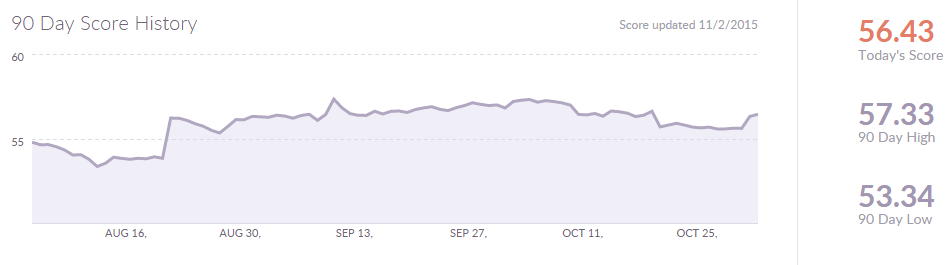
My Klout score has consistently stayed in the 55 to 57 range throughout this semester.


Klout graph.png

Before this semester, my score was consistently in the 53 to 55 range during the summer. 

There was a clear improvement in engagement when my friends returned from summer break.

Klout graph.png


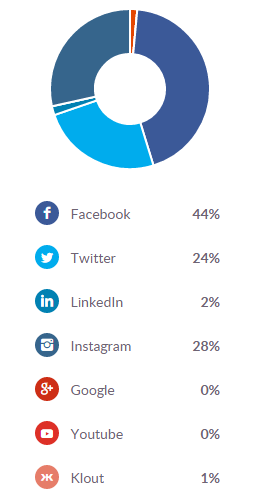
The majority of my engagement and influence takes place on Facebook, Twitter and Instagram.


As this pie graph from Klout shows, over a third of my engagement takes place on Facebook. 


Instagram and Twitter are the second and third platforms that I am most influential on.


I have tiny slivers of influence on LinkedIn and Klout, and none on Google+ and YouTube, which makes sense as I am not active on those accounts.


My blog is not very popular, as I am still trying to solidify the main goal of my blog. I am currently building up the amount of content I have on the blog, and once I find my actual niche, I will increase my promotion.
Google Search.png
Page views of my blog were at an all-time high in March 2015, with the inconsistency of my posting reflected in the inconsistency of page views.


While I tend to cross-post content across platforms well, there are not many calls to action. 
(Why is that important? Check out my blog about it).


Because most platforms have space for one website link, my accounts direct traffic toward my blog of my website.

website.png
My website hosts my blog and directs people out to my social media accounts, but if people do not take the extra step of looking at my website, they may need to use google search to find my other accounts.

Fourth: What should I focus on?


Here are six goals I want to focus on and how I plan on accomplishing them


1. Establish my blog as a credible source of information
-> Create a bank of content that I can work from to share content at consistent times
-> Narrow down the topics I cover on my blog, so the content itself will be more consistent
-> Interact with other bloggers with curated content and guest posts


2. Present a more consistent image of myself across platforms
-> Update information on all accounts at the same time
-> Blend the tones I use to interact with my two audiences, to present a consistent tone
-> Use more calls to action that connect my social media accounts


3. Engage both of my audiences more equally across social media platforms
-> Engage with content that is both fun and professional at the same time
-> Cross-post across all platforms when the format is applicable


 4. Be able to present my social media accounts as my resume when applying for a job
-> Consistently update my bio and about sections on all platforms
-> Curate my older content to remove broken links and incorrect information


5. Have a more influential voice on Twitter
-> Engage with brands on a consistent basis
-> Look for relevant conversations that I can engage with


6. Increase my engagement with followers
-> Post more interesting content across my social media accounts
-> Use calls to action in the majority of my posts to guide audience interaction


Off to check my social media accounts,
The Purple Writer

Monday, October 26, 2015

United Breaks Guitars

It's back!

Here's another post about the "United Breaks Guitars" case study.

I know I've written about or mentioned it a few times, but this is a new take, looking at other aspects of United Airlines and this viral video.


First: a quick and informal audit of United Airline's social media.


@United has a conversational and entertaining tone on its social media platforms, specifically Facebook, Instagram and Twitter.


As an example, the brand's recent posts have featured their new first class seats.                                                                                                                                                      
The brand tries to be funny and engaging while explaining how the new seats have been improved, and why these features are important.


United is most active on Twitter but does a good job of cross-posting the same content on Facebook and Instagram as well. 
The major campaign images and posts appear on all three platforms, while extra details and more posts will be seen on Facebook as compared to Instagram, and on Twitter as compared to Facebook.


United also does a pretty good job of listening to their audiences and followers on social media.                                                                                                        


Their responses are not generic or boring but are instead tailored to individuals, with the same caring and fun tone as their posts, and are signed by the team member responding.


They respond to comments, posts, tweets, and mentions, with usually only a few hours delay.


Now: what if this video was made today?


If Dave had flown on United Airlines today and complained about his guitar being mishandled, United would probably respond quickly and tried to help him in any way they could.

United's customer support has obviously come a long way in seven years and provides much better customer service today than they did when this video was created. 


Hopefully, the initial complaint would not be ignored or overlooked so he would not feel driven to create the video at all.

But if he did create this video today, in our digital age, I believe it would have received a different response.

The Hispanic imagery might be considered mildly offensive to some people, but that would not affect its popularity to a big degree, as the internet is filled with various degrees of offensive content that is popular.

No, the big thing that would affect this video's popularity is the fact that there have already been so many viral videos.


This video was revolutionary in its time, becoming essentially the first truly viral video.

But today, it could easily be just another funny video.

YouTube is filled with music videos, comedians, social commentary, and mixtures of all three. So while this video would probably garner some good attention today, it would likely not be a viral sensation.


Important takeaways:


Thinkers: Don't be afraid to try something new. 

You never know when your brain child might become huge and inspire multitudes of people, so don't be afraid to be the first.

Brands: Be ready to respond to anything.

Whether or not you believe claims or complaints, it's important to react quickly with a prepared team and a unified front. Even if you're facing a false claim, little things can have a big impact.


Planning to look at other case studies now,

The Purple Writer


Thursday, September 10, 2015

Why should I listen to you?

In general, everyone has something they want to say or communicate.


People tend to think their comments are important, sometimes more important than what other people are saying.

But what's the point of talking if nobody listens?


Here are some simple, yet important, rules to follow when communicating with the people around you, whether face-to-face or through social media.


1. Listen


You need to understand the current thread(s) of conversation before you try to jump in with your own thoughts.


Not sure what to pay attention to when listening to a conversation?


My infographic here may help.


You don't want your contribution to be redundant, unnecessary, or maybe worst of all, a conversation-stopper.


Don't bee that person who keeps talking without having anything to add.


The other members of the audience will be more likely to appreciate your opinions if they seem well thought out and relevant.


2. Engage


Now that you have a good grasp of what the conversation is about, you can share your opinions, right?

Slow down!

You should never blurt out your opinions and then walk away from the conversation. 


To begin with, you spent the time to understand the conversation, so you should be interested in where it goes and what conclusions are arrived at.


Secondly, people will lose respect for you and your opinions if you don't respect them and what they have to say.


Give the other members of the conversation a reason to listen to you by listening to them, processing what they said, and responding thoughtfully.


A little common courtesy goes a long way here.


Let's look at an example: The McWhopper.


Burger King recently wanted to enter the conversation centering around Peace Day, which is the United Nations' declared day of ceasefire and non-violence.

Now, engaging with an event like this can often be costly for companies, especially if their products do not directly relate to the main theme of the event.


However, Burger King wanted to use its large presence to help increase global awareness for Peace Day, and proposed a day of peace between its own brand and the the competing brand of McDonalds.


[ The official proposal and design for the "McWhopper" burger can be seen on this beautiful Tumblr website -> http://mcwhopper.com/ ]

McDonalds turned down Burger King's proposal, and that could have very easily been the end of this campaign.

But Burger King listened to its audiences and where the conversation was going, and realized there was a huge base of support for this idea of peace between competing food brands on Peace Day.

They have since opened the invitation up to all restaurants and brands which are interested in joining the conversation.


Whether a Peace Day burger is created and sold, or remains an idea, Burger King did a great job of spreading awareness of Peace Day and opening the conversation up to more global brands who otherwise may not have even considered taking part.


Communicating is a two-way street.


Remember to listen actively so you understand how to best interact with the conversation, and then stay engaged until the end.


Hungry for a Peace Day Burger,
The Purple Writer